

THE RETURN OF RESPECTABILITY POLITICS?
Reflections on the quarter-zip movement
Abigail Ingram
Nike Tech Suits are out—and the quarter zip is in. The recent trend-turned-movement initiated by influencer Jason Gyamfi has taken social media by storm. In a series of similar videos, young black men trade out their familiar sportswear for the classic quarter zip. Yet this simple upgrade is accompanied by much more than a dry cleaning bill. Lattes, literature, prestige—respectability.
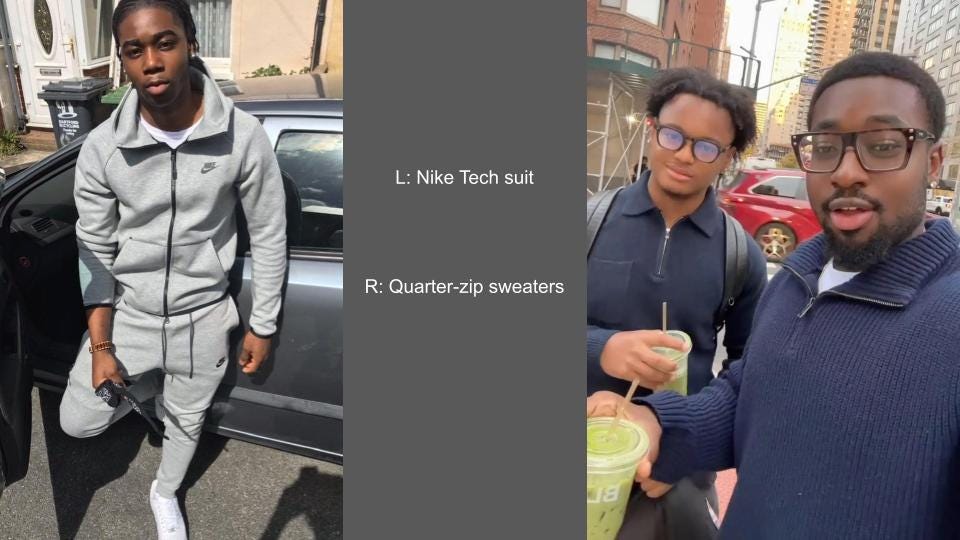
This trend, intended to be inspirational, has drawn significant criticism from within a particular segment of the black community. While some wholeheartedly embrace the elevated casual wardrobe and its accompanying lifestyle, others reject it, assuming the trend to be inherently anti-black.
There are two questions at hand. Is the quarter-zip movement, as identified by critics, simply a manifestation of respectability politics? And if so, is this a bad thing?
First highlighted by historian Evelyn Brooks Higginbotham in 1993, the politics of respectability signifies an attempt to reform “individual behavior and attitudes both as a goal in itself and as a strategy for the reform of the entire structural system of American race relations.” The term respectability politics (the more commonly used term), has taken on a somewhat more negative connotation. That is, to trade one’s true identity for a facade that is more acceptable to the public.
But the question of respectability politics gets to the very heart of what it means to be black. If wearing a quarter zip, drinking lattes, and reading books represent attempts to be something “other”—appropriation, if you will, of another culture—what is true blackness? And why would Nike Tech Suits, illiteracy, and a limited culinary palate be more authentic? My answer? They are not—and history shows it.
When I first saw Ralph Lauren’s Oak Bluffs Collection earlier this year I was impressed. Featuring a cast of black models, the campaign for the limited edition selection paid tribute not only to Martha’s Vineyard, but to the many African Americans who have visited the island since the late 1800s. Complete with the brand’s signature tailored tweed, the collection was not an attempt to fabricate a new kind of black culture, but to highlight a very real part of African-American history. As for the ads? They looked good.
Ralph Lauren was not the only organization to appeal to historic African-American fashion trends this year. When hosting its annual fundraiser gala in May, The Metropolitan Museum of Art opted for the theme Superfine: Tailoring Black Style—an ode to black dandyism. Prevalent throughout the early 20th century, this form of dandyism sought to use fashion as a tool to communicate pride, power, and dignity in a racially divided United States. With three-piece suits, bowties, pocket watches, and trench coats serving as staple garments and accessories, black dandyism is anything but casual, celebrating prestige and extravagance.
The Met Gala’s theme was well received. Yet those who are more critical of social media influencers’ recent push toward elevated casual dressing in black circles take issue with more than the clothing. They are skeptical of the association between respect and culture, as revealed through outfitting.
I have observed two problems with the most prevalent criticism of the quarter-zip trend. The first is that it ignores the political nature of fashion. The second is that it unintentionally presents authentic blackness as something opposed to classic, elevated, style.
Clothing choice contributes to a certain personal brand—it might well be the first thing an onlooker takes notice of. And though the old command “Don’t judge a book by its cover” has a particular appeal in some circles (especially those where critics of the quarter-zip trend are found), it carries little weight in the outside world. For better or worse, clothes do communicate something about the person wearing them.
While Nike Tech Suits demonstrate a prioritization of comfort at the expense of professionalism, the quarter zip affords a polished look without sacrificing simplicity. I appreciate the quarter-zip trend because it celebrates a part of black American culture that has been under-recognized in the mainstream. It is not a new phenomenon, but rather an appeal to a community that has historically taken pride in dressing well.
Could it also be a manifestation of respectability politics? Maybe. Is that a bad thing? I think not.

Abigail Ingram was born in Oxford, England and raised in Southern California. She is a graduate of Baylor University where she studied Political Science and History. Abigail was a 2024 Hudson Institute Political Studies Fellow, a research intern at the Cato Institute, a 2025 Acton Institute Emerging Leader and a Fall 2025 Fellow at the John Jay Institute.
We should totally bring back black dandyism. I am also for multiracial dandyism. Down with pajamas in public and super low rise pants. Gentlemen, please!
The things that people over-complicate never cease to amaze me. I'm not familiar with the cultural background to this particular kerfuffle, but I'll just say that as a woman I'd be far more drawn to the guys on the right than the guy in the track suit! They look stylish but not overdone.